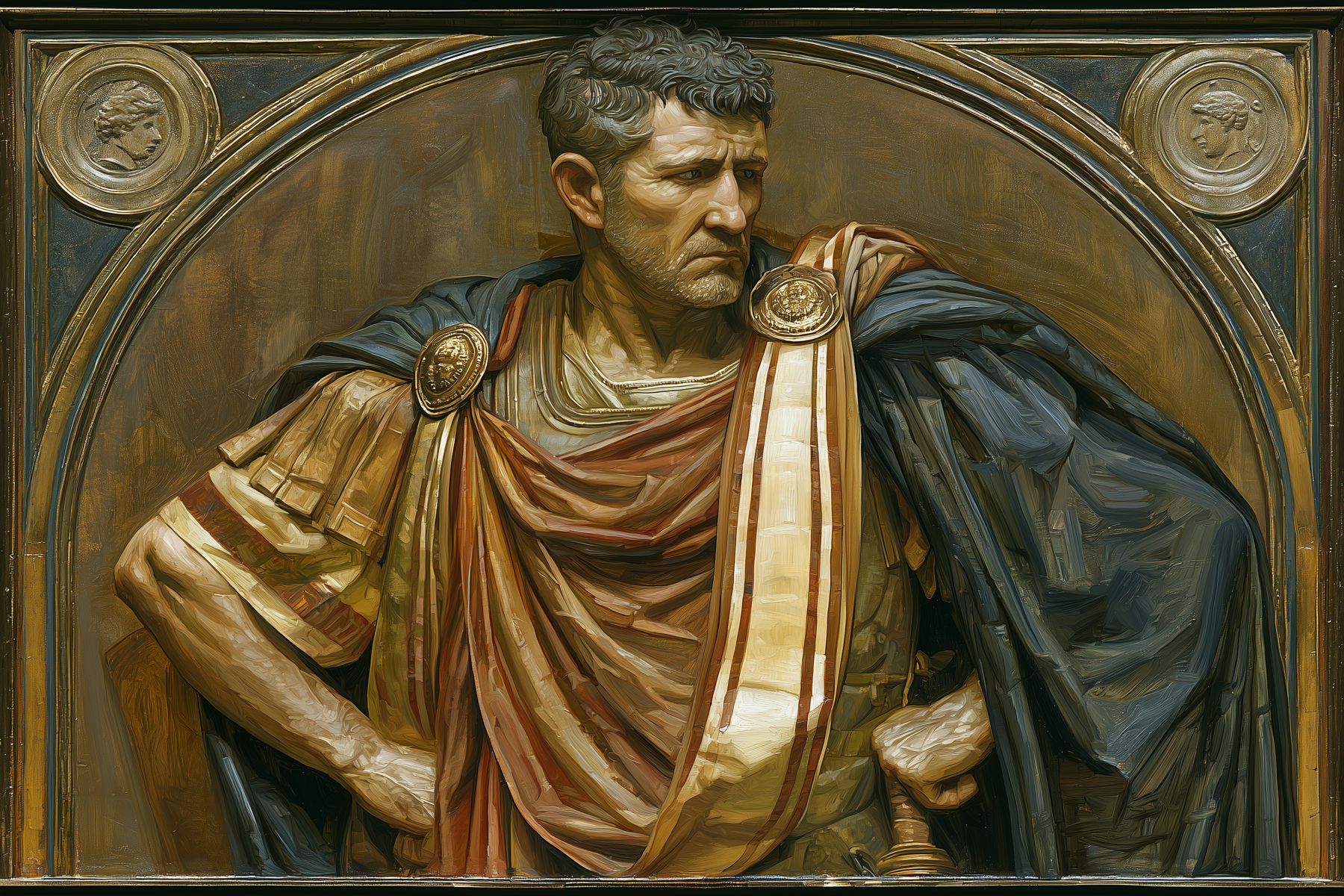
Aulus Platorius Nepos · Legatvs Avgvsti pro praetore · AD 122
Inscription knownDiploma dated · ad 122Likeness unknown
The GovernorBetween Orderand Stone
The man named on the Wall was not its designer. He was the authority beneath Hadrian and above the army that made it.
The honesty doctrine
Hadrian's Wall was not made by an emperor's hand. It passed through a chain of authority — from policy, through a governor, down into quarry faces, carts, turf, lime and men whose faces are lost. This page follows one rule: beautiful presentation must never make weak evidence look certain. Every non-trivial claim wears a chip saying how we know it — and where the record is silent, it says so.
Fidelity key
Inscription knownScholarly synthesis supportedDebated contestedReconstruction reasonedUnknown we say so
I
The Name
What the stones say
Inscription RIB · knownDiploma dated
His name survives where his face does not. On the Wall, Aulus Platorius Nepos appears not as a character in a story, but as authority made visible in stone — carved while the work was live. Most Roman lives reach us second-hand. Nepos reaches us first-hand, in cut stone and dated parchment.
The inscriptions do not give us a portrait. They give us a chain of command.
RIB 1638Milecastle 38 · HotbankHadrianic work by Legio II Augusta under Nepos — the build recorded at the scale of a single mile.Inscription known
RIB 1427Halton ChestersLegio VI Victrix at work on the fort of Onnum under Nepos.Inscription known
RIB 1340Benwell · CondercumA detachment of the Classis Britannica — the fleet — recorded under Nepos.Inscription known
CIL XVI 69British Museum diplomaFixes Nepos as governor of Britain by 17 July AD 122.Diploma dated
RIB 2401.6Military diplomaNames him still governor in AD 124 — the post held across the build.Diploma dated
Aquileia baseThe career stonePreserves his full cursus: senator, consul, augur, provincial governor.Inscription known
What the stones do not say
They name the governor who built it — not the mind that drew it. No surviving source names the Wall's designer, and no honest page should quietly promote the builder into the architect.
Designer unknownFace unknown
II
The Order Moves Down
The chain of authority
Roman command structure reconstructed
Hadrian's order did not fall straight onto a mason's chisel. It moved downward through the Roman machine — emperor, governor, legionary commanders, centurions, deputies, specialists and gangs. Nepos stood near the top of that order, but not alone over every stone.
Imperial policy
Hadrian
The visit, the frontier order, the decision to draw a line from sea to sea.
Provincial authority
Aulus Platorius Nepos
Legatus Augusti pro praetore — governor of Britain, executing the policy through the army.
Sector command
Legionary commanders
Legates, tribunes and camp prefects holding sectors of the line.
Daily control
Centurions & optiones
Work parcels, discipline, the day-to-day grip on each gang.
Stone, turf, clay, timber, carts, animals, roads, food — and names cut in stone.
Nepos stood above the work, but not alone over every stone. Roman command worked by layers: governor, legionary officers, centurions, technical specialists and named work gangs.
This is not a biography. It is a job description. A governor did not need to dress a single stone to be responsible for the Wall — his work was the machinery behind it. Nepos likely had to hold together, at once:
Imperial instruction from Hadrian and his administration
Army deployment across the province
Replacement and reinforcement of units
Line survey and local planning
Legionary work sectors along the line
Material supply — stone, lime, timber, food
Local security through the build
Land control and settlement clearance where required
Diplomacy and coercion with local peoples
Reporting back to Hadrian and the imperial centre
Inscriptions and public credit
A governor did not need to dress every stone to be responsible for the Wall. His authority moved through orders, documents, officers, punishments, rewards and the simple Roman fact that each work gang could be named in stone.
IV
The Makers Below Him
The Wall was army work
Inscription RIB · known
Below the governor stood the army that actually raised the Wall. The three legions of Britain carried the trained hands, the discipline and the technical habit to turn a frontier into measured labour — their names cut into the stone they set.
Plate IIlegionaries at work on the curtain image to be placed
Reconstruction · the makersarmy labour, not slave labour
Legio II AugustaA building legionNamed with Nepos at Milecastle 38 (RIB 1638).Inscription known
Legio VI VictrixA building legionAttested under Nepos at Halton Chesters (RIB 1427).Inscription known
Legio XX Valeria VictrixA building legionInscriptionally visible across the work alongside the other two.Inscription known
Classis BritannicaA fleet detachmentRecorded at Benwell under Nepos (RIB 1340) — not just legions.Inscription known
Centurial gangsWork-unit attributionA century's name could be cut into the Wall — but not an exact headcount or working day.Centurial stones attested
Red-line
Do not portray ordinary curtain-builders as either slaves or master masons. Ordinary Wall work was skilled enough to matter but trainable; gates and worked stones needed higher craft.
The Wall was army work. Not every soldier was a master mason, but the legions carried the trained hands, discipline and technical habit to turn a frontier into measured labour.
The fuller story — the plan that changed, the broad-to-narrow build, the anatomy of a section — belongs to a page of its own. See The Makers →
V
The Technicals
The missing designer was a habit, not a hero
Roman military practice reconstructed
The design of the Wall did not live in one man's heroic sketch. It lived in a military habit — a body of specialists who could make a line measurable enough to build. Each role below is reconstructed from Roman military practice unless tied to a named inscription.
MensoresSurveyors & agrimensoresSetting lines, distances, angles and parcels across eighty miles.Practice reconstructed
LibratoresLevellersGradients, levels, water and engineering contexts.Practice reconstructed
ArchitectiEngineers / technical plannersAttested generally in Roman practice — not named for this Wall.Practice reconstructed
FabriCraftsmenCarpentry, metalwork, tool repair, timbering and temporary works.Practice reconstructed
MasonsStone dressersFacing stones, quoins, voussoirs and the cutting of inscriptions.Practice reconstructed
Lime workersBurners & mixersLimestone burning and the mixing of mortar.Practice reconstructed
SmithsIron workersChisels, wedges, nails and fittings — kept sharp and replaced.Practice reconstructed
Cart teamsAnimal handlersMoving stone, turf, grain and timber by wagon and pack.Practice reconstructed
TabulariiClerks & writing staffLists, accounts, orders and receipts — the paperwork of a frontier.Practice reconstructed
The missing designer was probably not one man with a heroic sketch. The design lived in a military habit: surveyors, levellers, masons, centurions and record-keepers making a line measurable enough to build.
VI
The Work Moves Out
Materials & the bare land
Scholarly synthesis supported
From the order, the work spread sideways into the landscape: quarry faces, lime kilns, turf fields, carts, river crossings, bad roads, clay pits and bare ground stripped for foundations. Before the Wall was a monument, it was a working corridor of raw material.
Plate IIIturf · bare stripped ground · materials image to be placed
Reconstruction · materialstwo stone faces, a rubble-and-clay heart
Before the Wall was a monument, it was bare land being stripped, measured and disturbed: turf cut, clay lifted, stone dragged, spoil heaped, ditch lines opened, carts sinking into bad ground.
Sandstone facing blocks — the two outer skins
Rubble core — the messy local heart
Clay — bonding much of the core
Cobbles — bedding and rafts
Quarry waste — packed into the fill
Turf & sods — the western Turf Wall
Lime mortar — used unevenly, not poured
Timber — scaffolds, tools, carts, temporary works
Iron tools — chisel, wedge, crowbar
Rope — hauling and lifting
Water — for lime, men and beasts
Food supply — feeding the gangs
Leather & hide gear — harness and kit
Draft animals — the engine of transport
Red-lines · what this was NOT
The curtain was not "Roman concrete" and not poured — it was two stone faces with a rubble-and-clay heart. The lime binder was not modern cement. Not all of the Wall was whitewashed (lime leaching can mimic render). Not all visible fabric today is Roman. And the Military Way was not part of the first AD 122 plan — the first builders had the Stanegate and local tracks.
VII
Quarries & Stone
A working landscape, not one magic quarry
Inscription RIB · knownSupply routes uncertain
The Wall pulled stone from the landscape around it — nearby outcrops, lime zones, riverbanks, old faces in the rock. A few quarries are tied to the Wall by Roman inscriptions; many more are mapped but undated. We plot the points; we do not draw hard supply lines the evidence cannot carry.
The Wall was not carried from one magic quarry. It pulled on a working landscape: nearby sandstone outcrops, lime zones, riverbanks, tracks, old faces in the rock, short hauls and longer wagon journeys.
High · inscription quarryMedium · candidate / lime zoneLow · uncertain / lost / laterPoint anchors, not quarry polygons. Distance framing, not fixed supply lines.
Confidence tier is derived from each source feature's confidence note. Key pins to read: Combcrag (confirmed inscription quarry) · Queen's Crags (confirmed; an optio is named in RIB 3331) · Fallowfield Fell (the rock of Flavius Carantinus, RIB 1442) · Written Rock of Gelt (strong Roman quarrying, but a later repair context — not the AD 122 core) · Housesteads / Knag Burn (a lime zone, not just stone).
VIII
Sods & Soft Ground
In the west, the first Wall was not stone
Scholarly synthesis supportedLocal detail patchy
Richard's "sods" are the western Wall. For its first miles the frontier was earth and turf, not stone — but that turf was not random mud. It was cut, stacked and engineered into a barrier, and only later replaced in stone.
In the west, the first Wall was not stone at all. It was earth and turf, cut from the living ground, stacked into a frontier and later replaced in stone.
Turf WallThe western frontierEngineered turf blocks — cut, stacked and dimensioned, not heaped soil.Synthesis supported
Cobble raftsBurgh-by-Sands · SolwayTurf Wall set on a 6.1–6.2 m cobble raft across soft marsh ground.Excavated attested
Prepared basesStacked turves on stripped subsoilWhere the land softened, load was spread — local and patchy, not one universal recipe.Reconstructed site-specific
The honest limit
What survives across the soft ground is local and patchy, not one universal Roman recipe. The exact Wall line across part of Burgh Marsh remains uncertain.
IX
The Tools
The empire arrived as a chisel
Roman tool kit reconstructed
The Wall was built by policy, but it was made by tools. Most facing stones — averaging around 29 kg — could be manhandled by one or two men; the big gateway stones needed tackle. Here is the kit the order finally became.
Plate Vtools / a worked stone image to be placed
Reconstruction · the tool kitmost stones manhandled · big stones tackled
01
Chisel
Dressing the face
02
Punch
Rough shaping
03
Hammer / Mallet
Driving the edge
04
Wedge
Splitting the block
05
Crowbar
Prising stone free
06
Lever
Shifting the load
07
Measuring rod
Setting the dimension
08
Plumb line
Holding the vertical
09
Groma
The survey frame
10
Rope
Hauling & lifting
11
Basket
Carrying core & spoil
12
Cart wheel
The wagon train
13
Lifting tackle
For the heavy stones
14
Stylus & tablet
Tally & order
15
Guide line
The cutter's lettering
The tools were not glamorous. The empire arrived as a chisel, a wedge, a rope, a tally, a cart, a measuring line and a man telling another man where to stand.
X
The Quarry Face
Who stood at the quarry?
Inscription RIB 3331 · optioChain reconstructedThe named overseer lost
Richard asked the right question: someone surely controlled each active quarry — who, what rank, where did he stay, and was he below Nepos? Someone did stand at the quarry and give orders. We do not know his name. He was almost certainly not a governor. The evidence points lower.
Plate IVa quarry face image to be placed
Reconstruction · the quarryquarry faces survive · not his bed
Quarrying was organised, not casual. Inscription quarries show military presence and named individuals. At Queen's Crags, RIB 3331 names an optio — direct evidence for a sub-centurion officer appearing in a quarry inscription. The likely chain at any one quarry runs far below the governor:
Provincial governor
Nepos
The signature at the top of the order — not a site foreman.
Legion command
Legionary legate
Lower than Nepos, but still a senior senator commanding a legion.
Logistics staff
Tribune / camp prefect
Below legion command; could handle large logistics and technical oversight.
Day-to-day control
Centurion
The safest rank for hands-on control of a work party or sector.
Delegated on site
Optio · principalis
A centurion's deputy — RIB 3331's quarry optio makes this the visible clue.
The work
Specialists & work gang
Skilled immunes and ordinary soldiers under legionary discipline.
If Nepos was the signature at the top of the provincial order, the quarry face belonged to lower military command: centurions, optiones, specialists and work gangs. The exact quarry overseer is lost.
Where would he have stayed? Unknown for any named overseer. Plausible, and labelled reconstruction: a temporary work camp near the quarry; a nearby fort, fortlet or milecastle if close enough; tented accommodation during active extraction; a construction compound with animals, carts, tool repair and guards; or, for senior officers, the nearest fort command building.
A quarry overseer probably slept where the work demanded: in a temporary camp, nearby fort, tented compound or construction post. The evidence gives us quarry faces and inscriptions, not his bed.
What would he control? Keeping the work party present and counted; opening quarry faces; rough block extraction and wedge work; rough dressing; spoil and reject piles; cart loading and wagon timing; tool repair; rations and water at the work point; safety and discipline; recording output by tally; and marking the work if required.
What not to say
Do not call him a "quarry master" as a known Roman title for the Wall. Do not give him a name no inscription gives. Do not invent a permanent quarry-master's house. Do not make Nepos a site foreman, and do not say quarry labour was slave labour for the Wall.
XI
The Honesty Close
The missing designer
Designer unknown
The Wall has an emperor, a governor, legions and work gangs. What it does not have is a named designer.
The absence matters
The absence matters. A beautiful page could quietly invent an architect to round off the story. This one does not. Nepos set out the line and held the schedule; he did not draw the plan. The mind behind the Wall is silent in the record — and we say so.
This is not a page about a face. It is a page about authority becoming labour — from Hadrian's policy, through Nepos as governor, down into quarry faces, carts, turf, lime, tools and men whose faces are lost.